


 Google Rating 400+ Reviews
 Mon To Fri: 8:00am - 5:00pm
 1800 548 502





What Is Dead Air Space? Why Smoke Alarm Location Matters More Than Most People Think
 June 19, 2026
Most folks assume that if a smoke alarm beeps when you press it, then everything is hunky dory.
Well…unfortunately, that’s not the case.
After completing tens of thousands of smoke alarm inspections across Melbourne and Victoria, there a number of issues we find beyond an expired alarm.
One of those many issues is smoke alarm placement on a ceiling space.
And one of the biggest culprits is something called dead air space.
Most landlords and property managers have never heard of it.
In fact, many electricians don’t even know what it is.
But understanding dead air space and correct smoke alarm placement may be the difference between your alarm sounding early, saving your house…and maybe even your life.
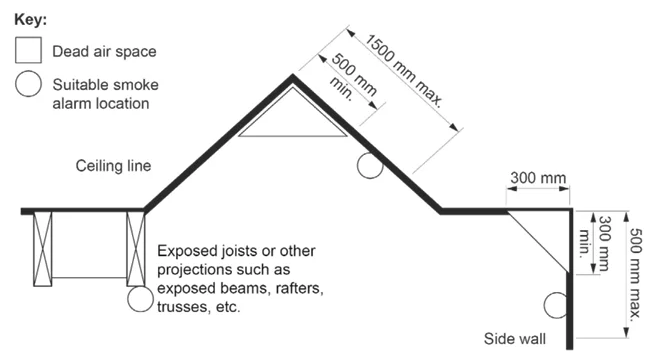
Dead air space, as the name suggests, is an area where air movement is ‘dead’ or stagnant, causing smoke to take longer to reach this area.
These pockets of air typically occur:
- Where walls and ceilings meet
- At the apex of a cathedral ceiling
- Around beams and bulkheads
Because smoke relies on airflow to reach the alarm, a detector installed within these areas may not provide the earliest warning possible.
Summary: Dead air space is a pocket of stagnant air that is most commonly formed where walls and ceilings meet. Smoke alarms installed in this space may not detect smoke as quickly as otherwise, hence should be installed at least 300mm from the ceiling boundary to conform with the National Construction Code (mandatory from 2018 onwards).
Why Does Dead Air Space Exist?
Hot smoke rises.
As it reaches the ceiling, it spreads out across the room.
However, right where the ceiling meets the wall, the movement of air slows dramatically.
Think about a river.
The water flows fastest in the middle.
Near the riverbank, you’ll often see small pockets where the water barely moves.
Air behaves in a similar way.
Those pockets of relatively still air are what we refer to as dead air space.
The problem is simple.
If smoke isn’t moving into that area quickly, neither is the warning.
Where to install a smoke alarm (standard ceilings)
One of the most common defects we find is smoke alarms mounted hard against the wall.
According to the guidance contained within Australian Standards and the National Construction Code, smoke alarms installed on flat ceilings must be positioned at least 300mm away from wall junctions.
This outer 300mm perimeter is considered dead air
Where to install a smoke alarm (cathedral ceilings)
Pitched and cathedral ceilings create a different challenge.
Many people assume the smoke alarm should be installed at the very highest point.
In reality, the apex itself can become another dead air space zone.
Instead, smoke alarms are generally installed between 500mm and 1500mm below the highest point of the ceiling.
Mounting an alarm directly on the apex can delay smoke detection.
Why This Matters
The scary part is this.
Most of these alarms still work.
The battery is good.
The test button works.
The alarm sounds.
But pressing the test button doesn’t tell you whether smoke will reach the sensor quickly enough during a fire.
And that’s what smoke alarms are designed to do.
Provide early warning.
Because in a fire, seconds matter.
Are smoke alarms in dead air space not compliant?
Dead air space was introduced as mandatory in the Australian Standards in the National Construction Code from 2018 onwards.
As such, any smoke alarms/buildings installed prior to this date are technically compliant (as legislation is not retrospective).
However, this regulation is a welcome addition to the regulations as it can actually save lives. As such, at Compliance Fixer if we find this in a safety check we would make this a recommendation at minimum.
Summary
Smoke alarms only have one job.
To give occupants enough time to escape safely.
That’s why location matters just as much as the alarm itself.
At Compliance Fixer, we inspect thousands of properties every year and dead air space is one of the most common installation issues we come across.
The good news?
It’s usually a simple fix.
And it’s a reminder that when it comes to life safety, close enough isn’t always good enough.
Frequently Asked Questions
For flat ceilings, smoke alarms must be be installed at least 300mm away from wall junctions to avoid dead air space.
Dead air space is the pocket of stagnant air that forms where walls and ceilings meet. Smoke alarms installed in these areas may respond slower to smoke.
No. Corners are considered dead air spaces and are unsuitable locations for smoke alarms.
Yes. Strong airflow from air-conditioning outlets and ceiling fans can interfere with smoke reaching the detector. However, there are no direct regulations around this.
Yes. Smoke alarms must be installed in accordance with Australian Standards and manufacturer instructions. Incorrect placement may result in non-compliance. Dead air space was introduced into the Australian Standards in 2018 so was mandatory for buildings built after this date (and recommended before).

 1800 548 502
June 18, 2026
June 17, 2026
1800 548 502
June 18, 2026
June 17, 2026 

